





Look at the glass surface
Measure the pane on which the pleated blind will go. Check the edges and any division into panes.
With steel windows, you want to keep the slim profiles visible. Stick & Fit is attached directly to the glass with very narrow adhesive profiles, without drilling into the steel window frame.
You move the top and bottom rails independently of each other. This lets you block the view in exactly where it occurs and let daylight in above or below the fabric.
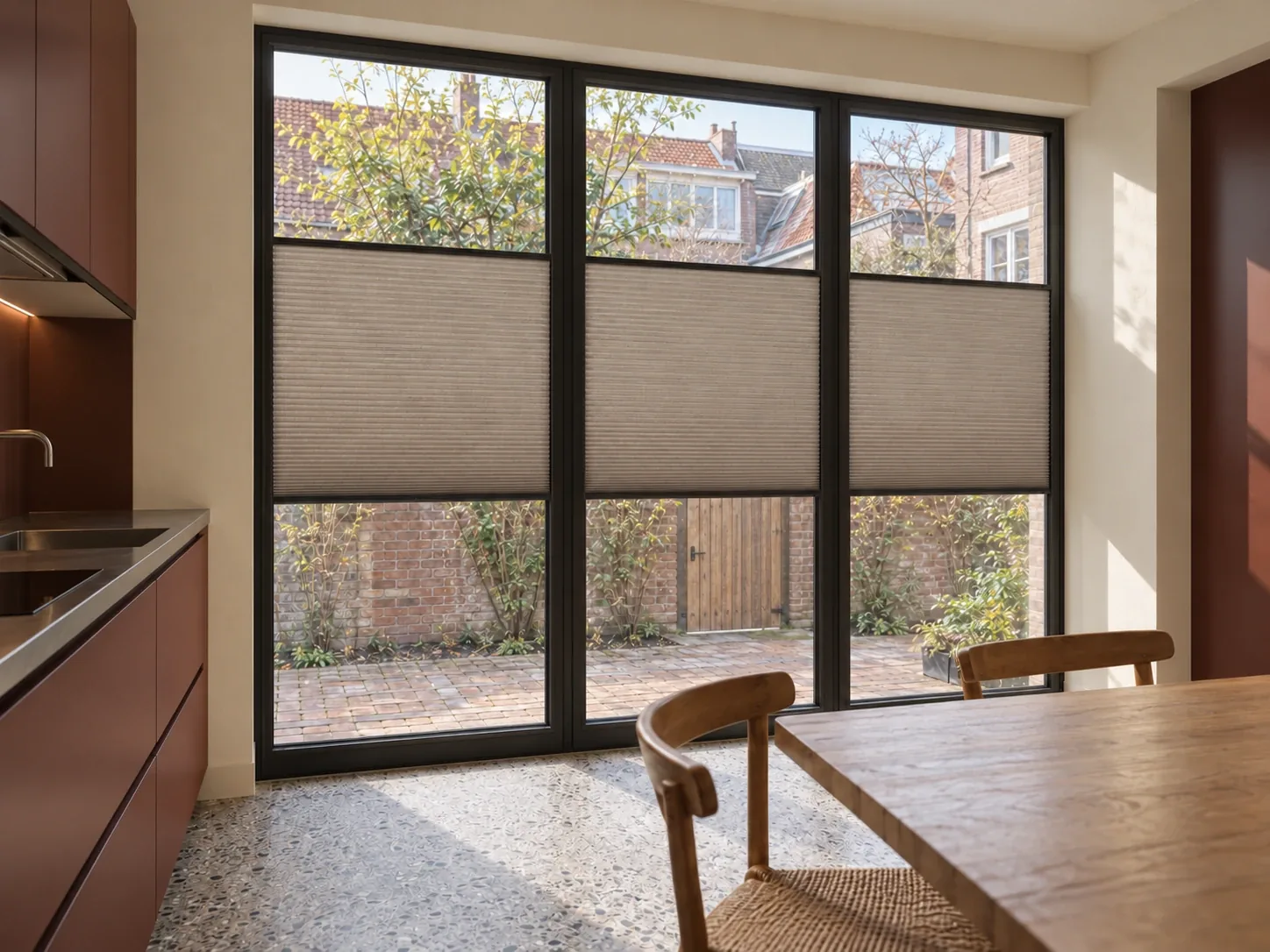
The adhesive profiles go on the left and right of the glass. The cords run hidden behind these narrow vertical profiles. You operate the pleated blind directly with the top and bottom rails; there are no loose pull cords hanging beside the window.
The glass size, any glazing bars and the window hardware determine how the system fits your window. We look at this just as carefully for existing steel windows as for a new steel glazed screen.
Measure the pane on which the pleated blind will go. Check the edges and any division into panes.
Pay attention to window handles, catches and moving parts. Allow for a system depth of 32.2 mm.
Slide the fabric in front of the part where people can see in and leave the rest of the window open as you wish.
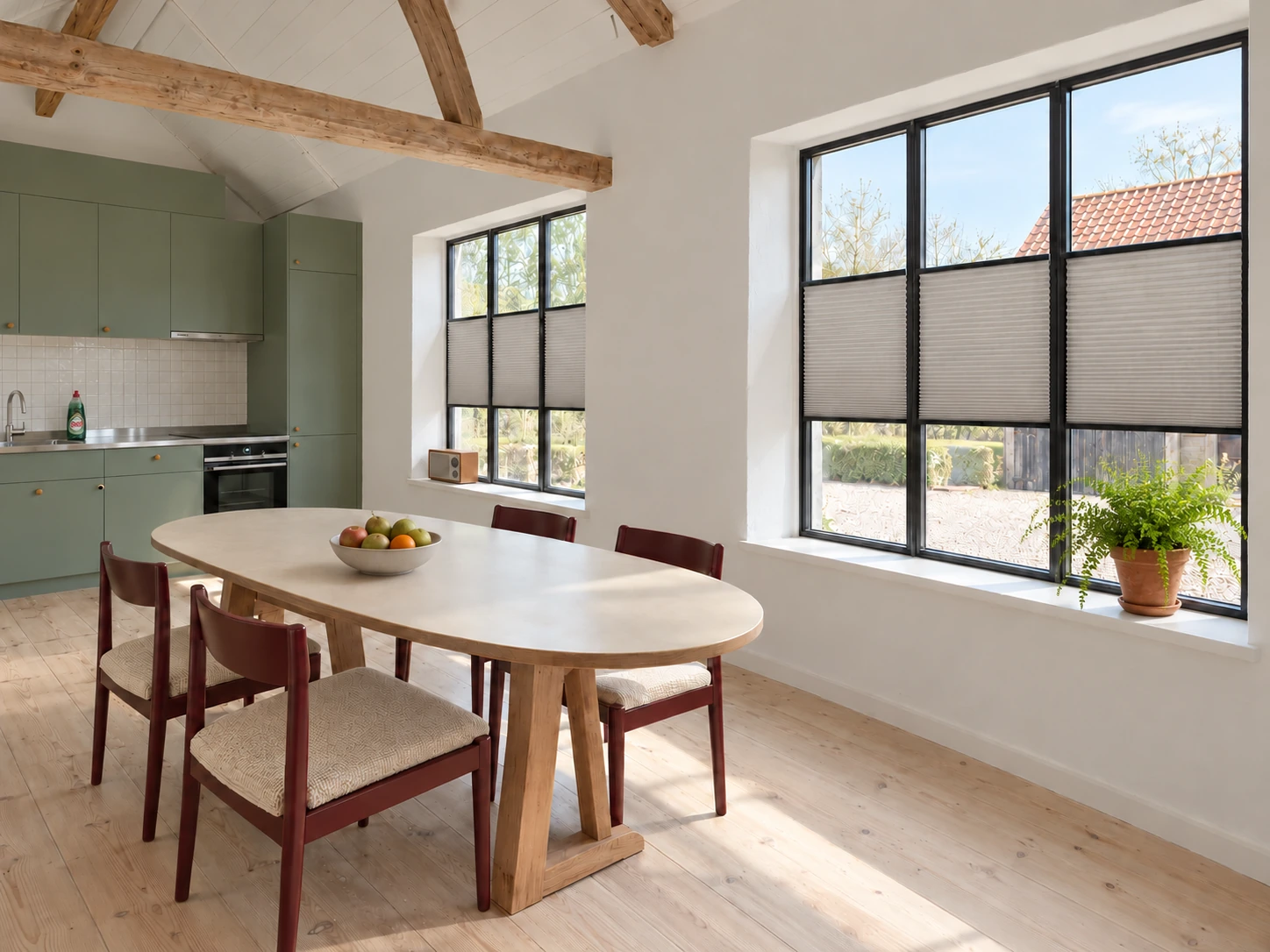
The pleated blind sits close to the glass. That suits steel windows whose slim lines you want to keep seeing.
At the kitchen windows, the fabric blocks part of the view in. The glass above the fabric stays clear for daylight. You move the two operating rails independently of each other.
The adhesive profiles are attached to the glass. No screw holes in the window frame are needed.
The vertical profiles take up little space and hide the system’s cords.
With top-down/bottom-up, you decide which part of the window you screen off.
For each suitable window, you choose the size, fabric and finish that suit it.
The honeycomb fabric traps air and helps to limit heat and cold at the window.
Choose the adhesive profile and operating rail separately from five standard colours, with no colour surcharge.
Choose from 34 honeycomb fabrics of 25 mm: light-filtering for filtered daylight or Black-out for a room-darkening fabric surface. A dark fabric colour alone does not determine how much light the fabric lets through.
The same colour on both sides. The fabric blocks the view in and lets filtered daylight through. Suitable for a kitchen, living room or workspace, for example.
The same colour inside and outLight-filtering, with a colour of your choice on the inside and white on the outside. Handy when you want different rooms to blend into one calm façade.
Colour inside, white outsideThe fabric itself lets no light through. A suitable choice for sleeping or strong light reduction. Depending on the window, some light may still be visible along the edges.
Blackout fabric; light at the edges remains possibleMatch the adhesive profile to the window frame and choose the operating rail to go with the fabric, or give both the same colour. You choose each component separately from the five standard colours.
RAL 9005 often looks good with black steel; with anthracite, RAL 7016 is the more obvious choice. Light-coloured steel window frames can also be given a matching finish. Compare the colour at your window.
More colour advice: pleated blinds with black window frames.
Measure each window separately, even if the windows look the same. With steel, the glass edge, catches and any division into panes deserve particular attention.
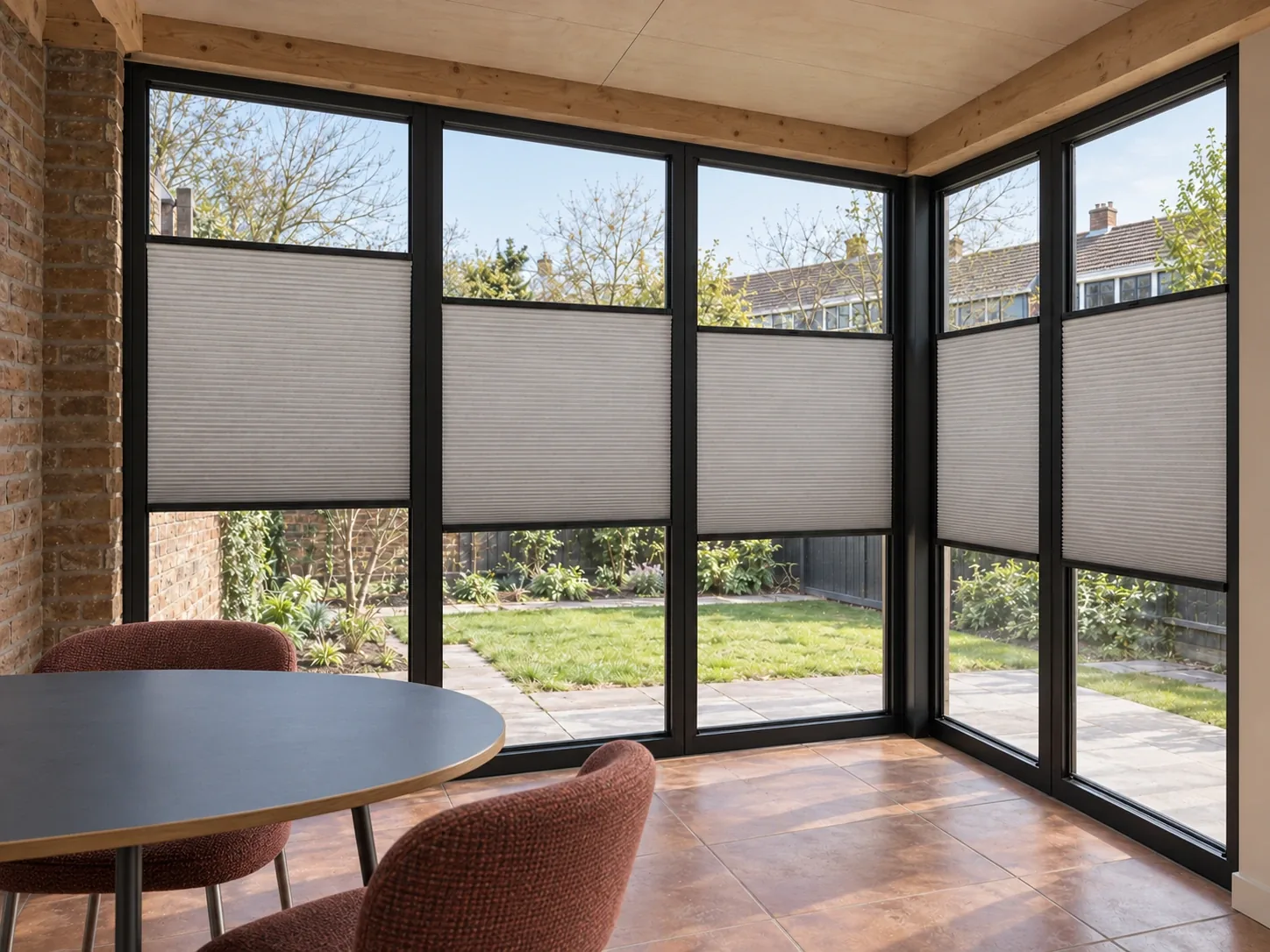
A steel window can consist of separate panes, but also of a single pane with decorative glazing bars. So look at how your window is actually built up.
With separate panes, you measure each glass surface individually. With decorative glazing bars, what matters is where they are: on the inside, on the outside or between the glass. Protruding parts on the room side can affect the fitting.
If in doubt, send a photo of the whole window and a close-up of the glass edge. We will then help you find a suitable layout.
A made-to-measure pleated blind for every suitable glass surface.
*The maximum height depends on the width. The configurator checks the combination. Ask for advice if your size falls outside this range.
| Width | Max. height |
|---|---|
| 230–900 | 3000 |
| 901–1000 | 2900 |
| 1001–1100 | 2800 |
| 1101–1200 | 2700 |
| 1201–1300 | 2600 |
| 1301–1400 | 2500 |
| 1401–1500 | 2300 |
| 1501–1600 | 2200 |
| 1601–1700 | 2000 |
| 1701–1800 | 1900 |
Aluminium with a steel look? Aluminium can also have narrow, dark profiles. In that case, take a look at the advice for aluminium window frames.
Compare the fabrics at your steel window frame, during the day and with the lights on. Choose light, colour and privacy in your own room.
Your Stick & Fit is made to measure. For standard sizes, the delivery time is approx. 8–10 working days.
Free delivery in the Netherlands, Belgium, Germany and France.
Clean and degrease the pane according to the instructions. Make sure that both the glass and the surroundings are between 15 and 35 °C.
Do not operate the pleated blind for the first 24 hours after fitting. This gives the adhesive bond time to set properly.
Not sure about glazing bars, the glass edge or a window handle? Send an overview photo, a close-up photo and the measurements.
Yes, if the glass surface is suitable. Stick & Fit is attached to the glass with adhesive profiles. The glass size, glass edge and space around the hardware determine whether the design fits.
A narrow window frame need not be an obstacle in itself, because the adhesive profiles go on the glass. Do check the available glass size and the system depth of 32.2 mm.
We assess that based on the window. Send an overview photo, a close-up of the glass edge and the measurements. That way we can assess the fitting before you order.
Check whether they are separate panes or a division on a single glass surface. The dimensions and build-up determine where the pleated blind can go. If in doubt, we can take a look using a photo.
With suitable positioning, the pleated blind moves with the window section. Check in advance whether handles, catches and other parts can move freely past the profiles and operating rails.
Choose Black-out for that. The fabric lets no light through. The overall darkening also depends on the fit along the glass edge; a small gap of light may remain there.
Yes. You choose both components separately from RAL 9003, 9001, 7035, 7016 and 9005, with no colour surcharge. That way the profile can match the steel and the rail the fabric.
Measure each glass surface separately in millimetres. Measure the width at the top and bottom and the height on the left and right, and use the shortest width and height. Do not make any deductions yourself. The maximum height depends on the chosen width; the configurator checks this combination.
Choose up to 8 free fabric samples and compare them at your window frame. With the colour of the steel, the daylight and your interior alongside, you can see which fabric suits best. See all prices by size.
No damage to your window frame
A perfect fit for every window
Improved insulation and blackout
Privacy, blackout and insulation
In the Netherlands, Belgium, Germany and France