





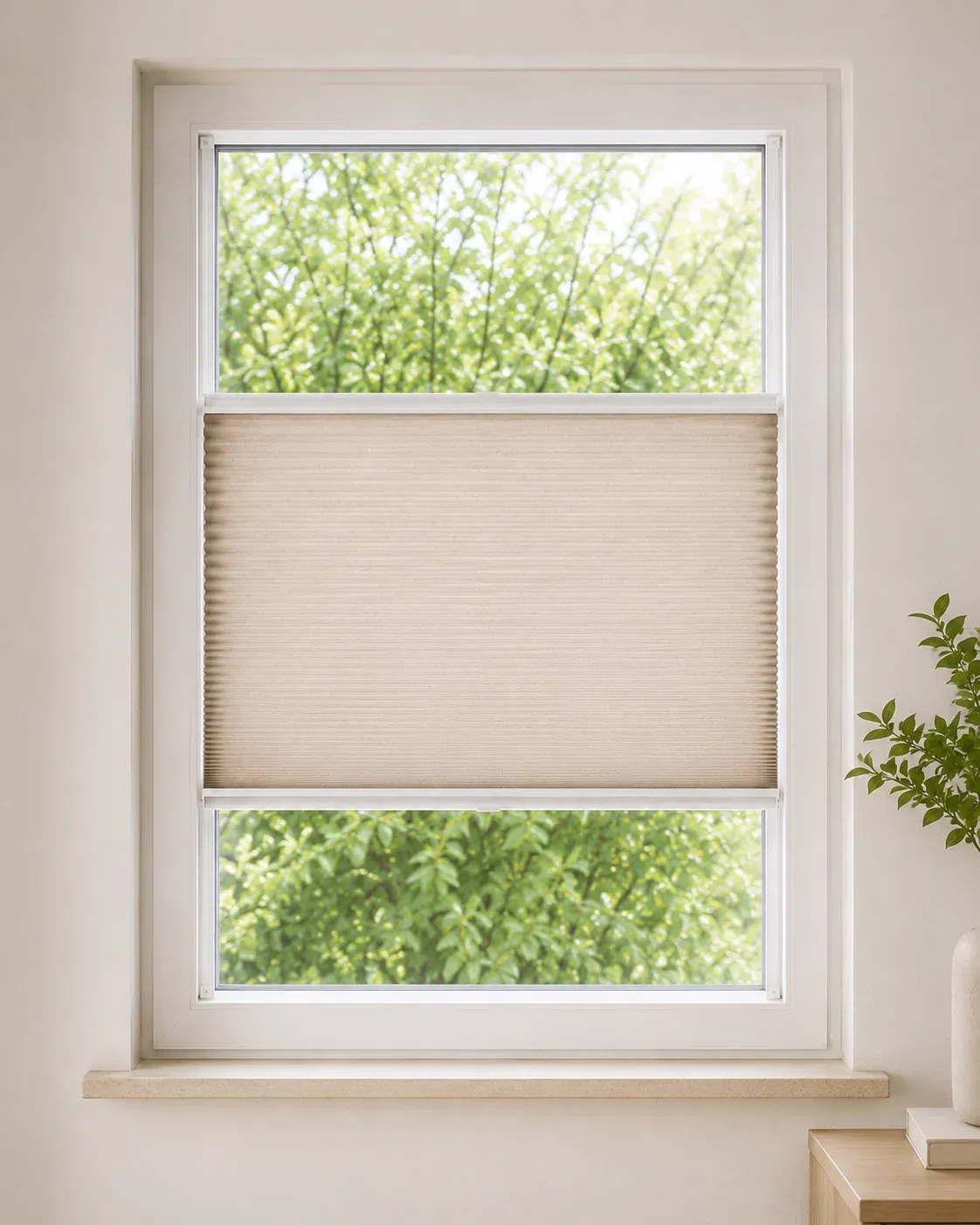
Only the middle closed
Both rails are away from the edge. The fabric hangs as a band across the line of sight, while the glass stays open both above and below. This is the position that cannot be achieved with a fixed top.
You move the top rail and the bottom rail independently
With a top-down/bottom-up pleated blind you move the top rail and the bottom rail independently of each other. This lets you screen exactly the part of the window where people can see in, while the rest of the glass stays open to daylight. Stick & Fit has this operation as standard and is fitted directly onto the glass without drilling.
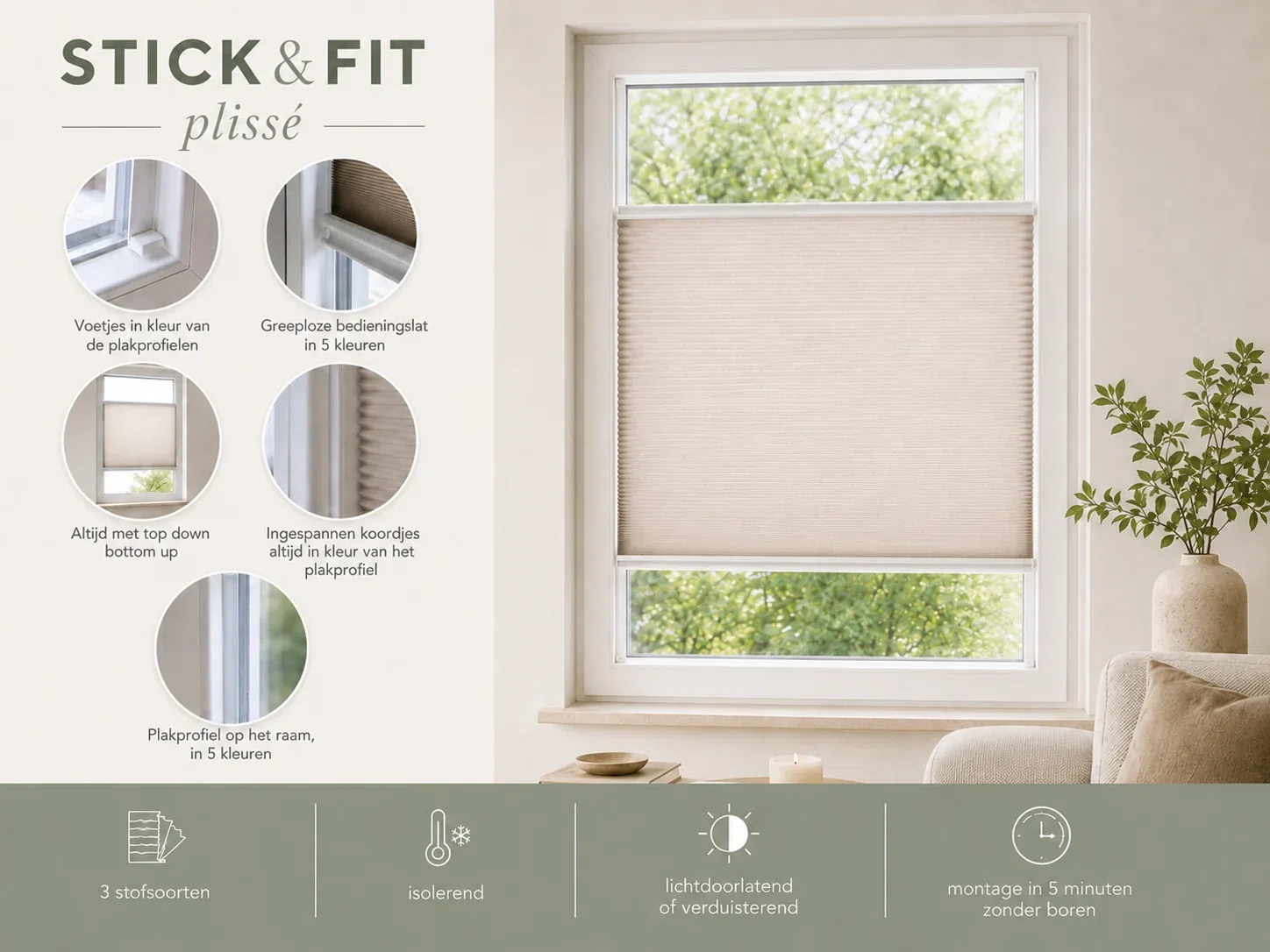
Operation in brief
With a pleated blind that has a fixed top, you can only move the fabric up and down from the bottom. If you want privacy at eye level, you automatically close the lower part of the window as well. With top-down/bottom-up, the pleated fabric hangs between two operating rails that can both be moved.
You take hold of the hollow, handle-free rail with your fingers and slide it to the height you want. The cords that keep the fabric taut run along the glass in the same colour as the chosen profile; there is no loose cord or chain hanging from the blind. Operation is infinitely adjustable, so rather than fixed positions you choose any height in between.
Both rails are away from the edge. The fabric hangs as a band across the line of sight, while the glass stays open both above and below. This is the position that cannot be achieved with a fixed top.
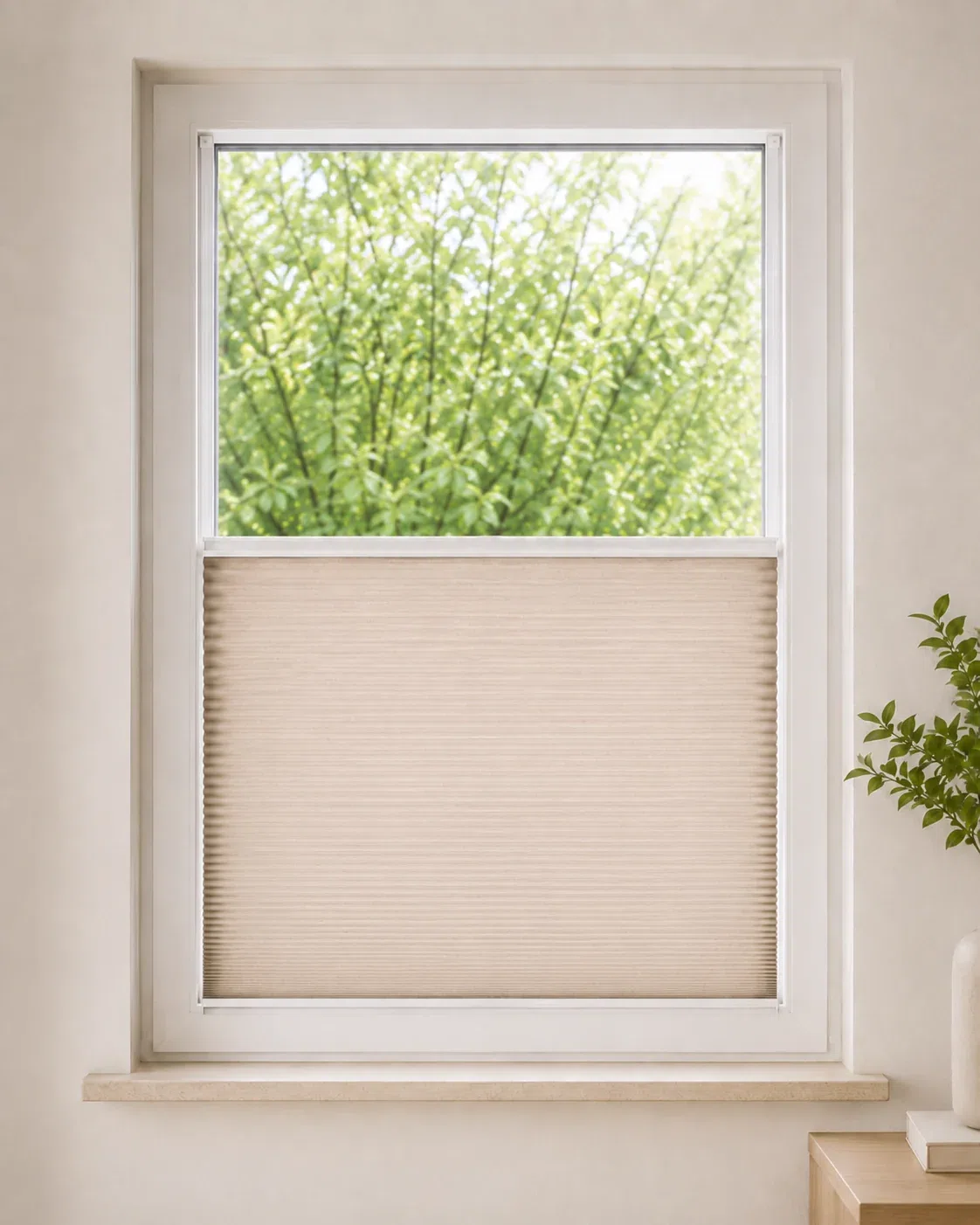
The top rail slides down and covers the top half. Useful against bright incoming light or against people looking in from above, for example from an access gallery, while you can still look out underneath.
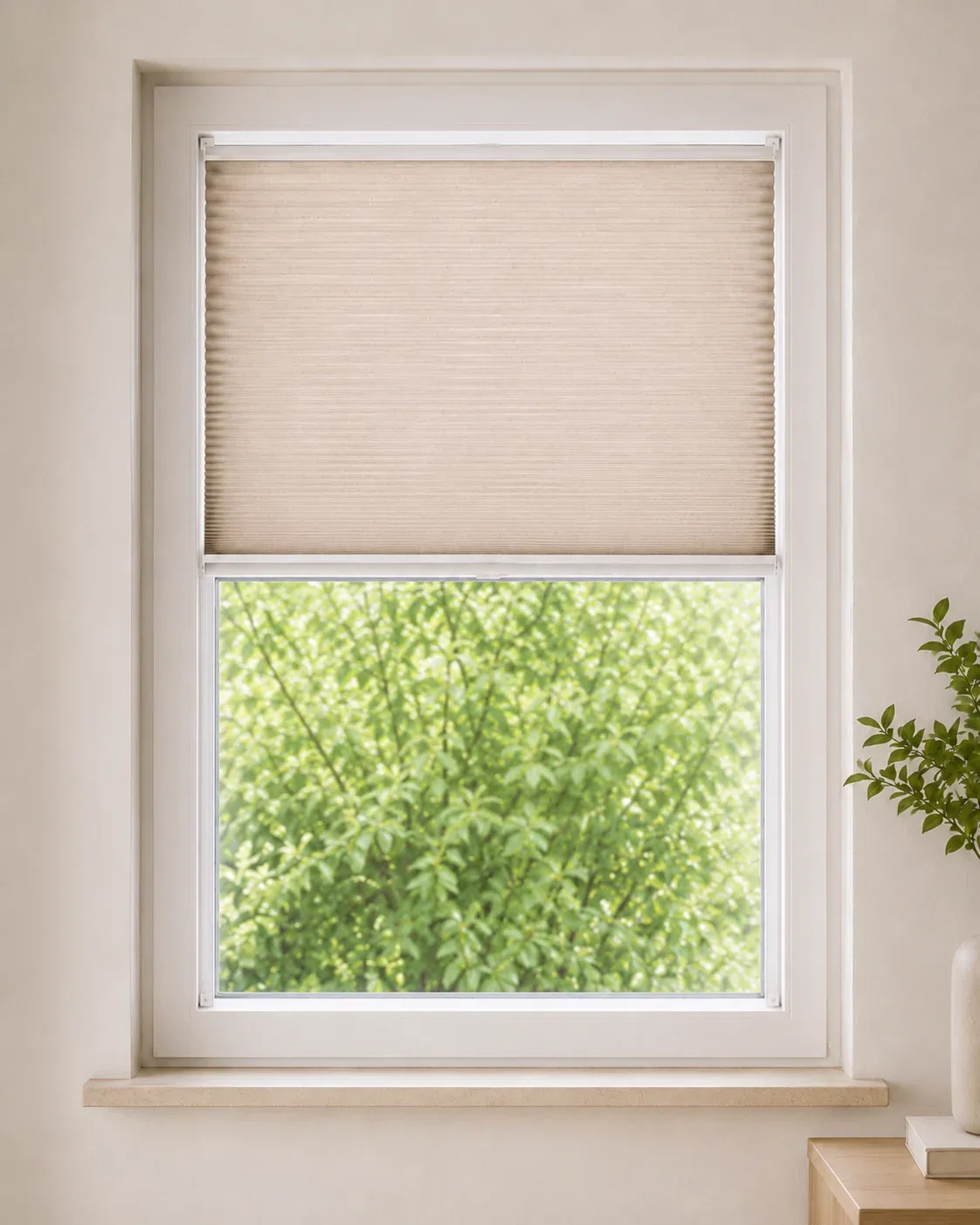
The bottom rail comes up from the windowsill. This is the most familiar position against people looking in from the street, pavement or garden path, with light coming in fully at the top.
Difference from a standard pleated blind
The difference is smaller than it sounds and the effect is greater. Everything about the fabric stays the same; only the way you position it changes.
The same pleated honeycomb fabric, the same colours and the same made-to-measure precision to the millimetre. Choosing this operation does not limit your choice of fabric.
With a fixed top, the upper part of the window is always open or always closed. Here you move that rail just as easily as the bottom rail.
Not only how much of the window you cover, but also where. This lets you block the view in at one height without closing the entire pane.
What fitting without drilling adds
The operation determines how you control light and privacy. The fitting method determines how the system sits in the window and what it requires of your window frame.
Two narrow adhesive profiles on the left and right of the glass. No drill holes, screws or wall plugs in the window frame.
No surrounding frame around the window. The system is 32.2 mm deep and the windowsill stays clear.
No fixed number of positions. You slide both rails to any height you like over the full window height.
No chain and no loose cord along the window. You operate the system with the handle-free rails themselves.
The blind sits on the moving glass section and stays tight against the glass when a tilt-and-turn window or door is opened.
Each pane gets its own product and therefore its own position. With windows side by side, you choose per pane what is closed.
Single Tone and Duo Tone let filtered light through, Black-out is blackout. All three are opaque where the fabric hangs.
Five adhesive profile colours and five operating rail colours, chosen independently of each other.
Privacy without closing the window
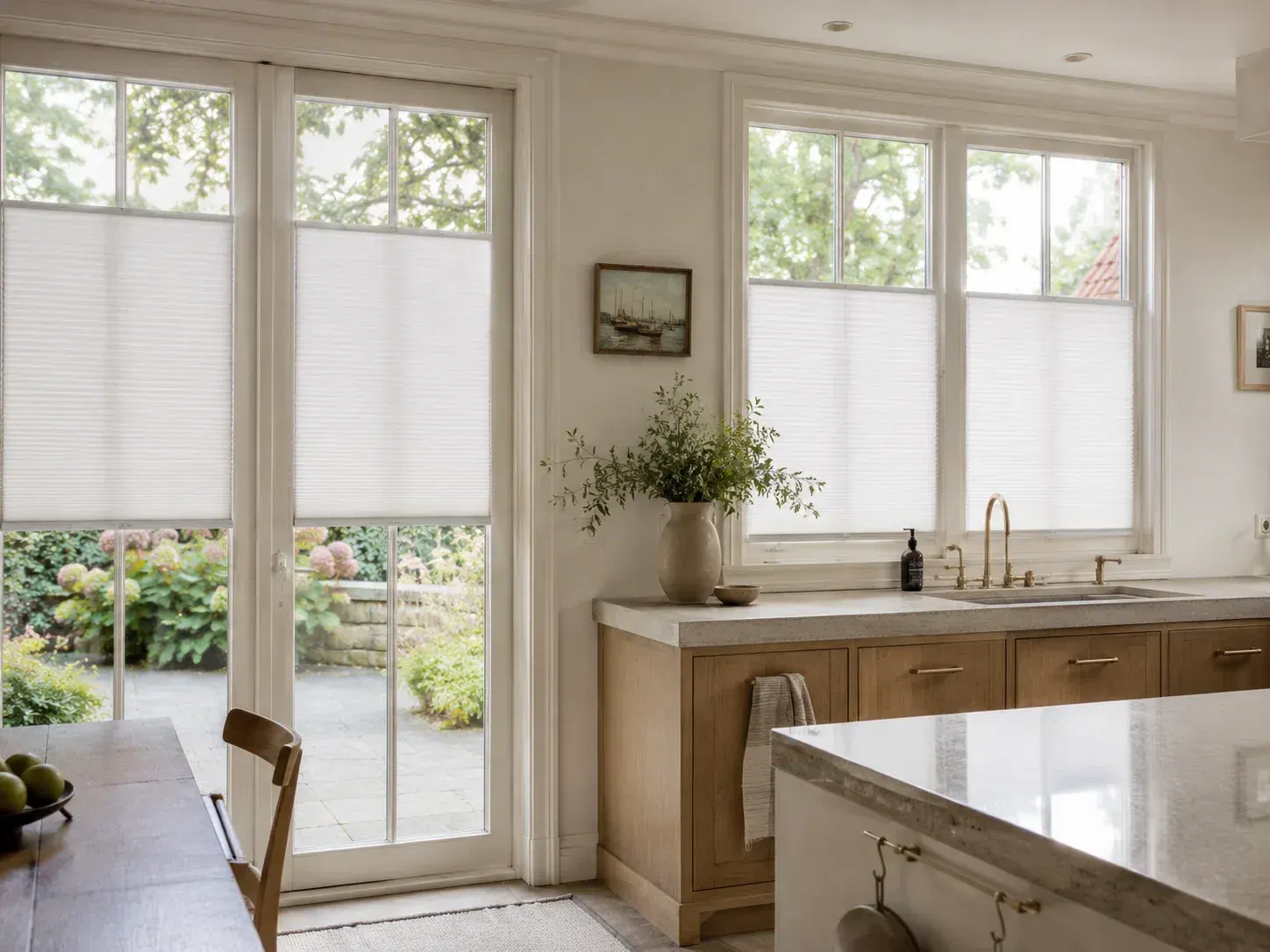
People see in at one height: the line between the eye of a passer-by or neighbour opposite and the spot where you sit or stand. That is a band of a few tens of centimetres, not the whole window. A top-down/bottom-up pleated blind covers exactly that band and leaves the rest open.
The fabric itself is opaque, including the light-filtering Single Tone and Duo Tone. So where the fabric hangs, there is no see-through — in either direction. The daylight that comes in consists of the open part of the window plus the light filtered through the fabric.
Looking for your situation rather than the technology? Then read on about privacy without losing daylight or about window coverings against prying eyes.
Controlling light throughout the day
Because operation is infinitely adjustable, changing the position takes two hand movements. These four moments apply to most windows.
Both rails out of the way. The pane is completely clear and the room fills with daylight.
Bottom rail up to just above eye level. You are out of sight and can still look out over the top.
Top rail down against bright light falling on a screen or table, with the bottom open.
With artificial light, people outside can see further in. Then close the fabric over the full height.
Bathroom and toilet
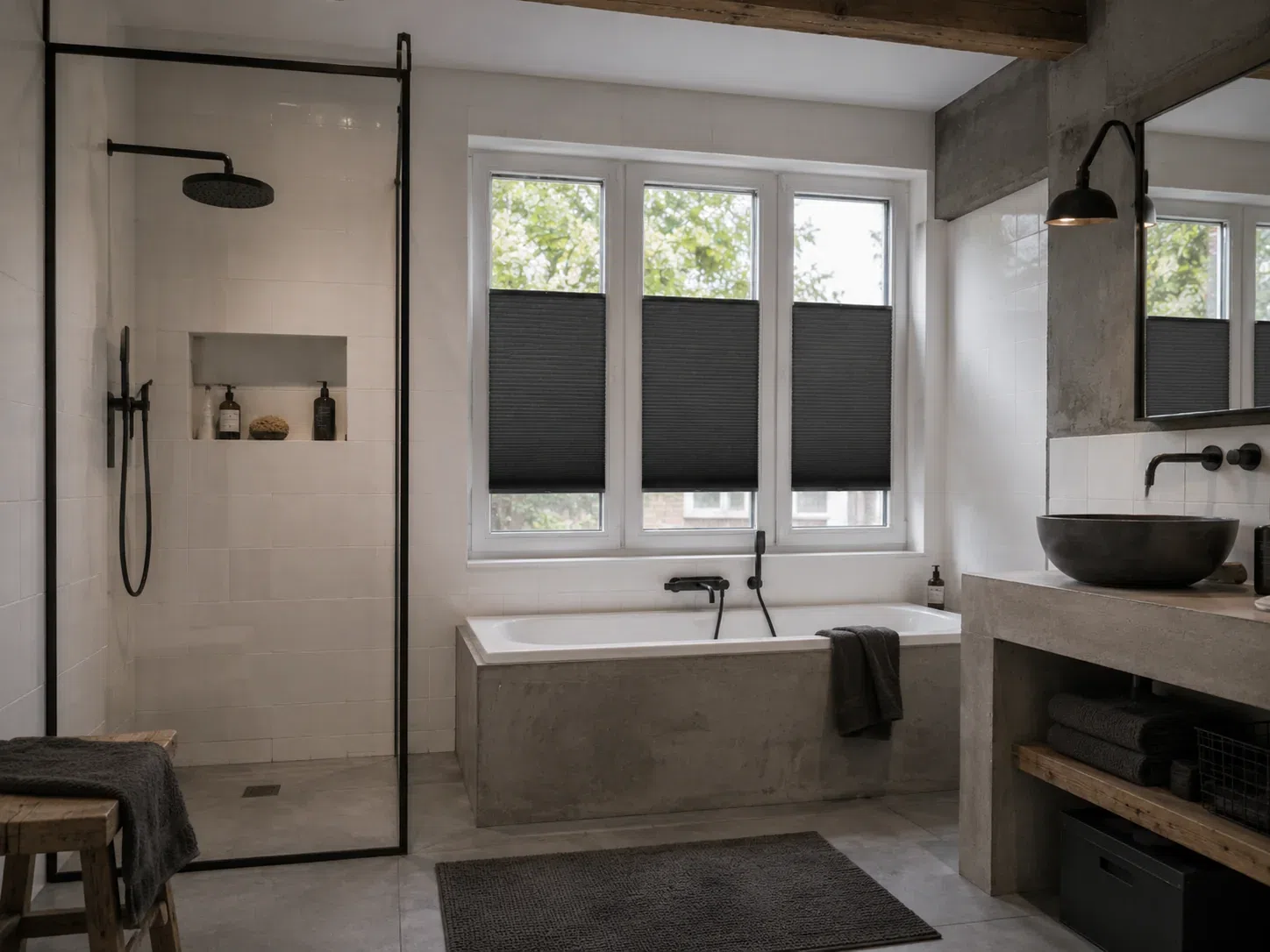
For a bathroom window, window film is a popular solution against people looking in. Film works, but it is fixed: the effect is the same day and night, and you cannot undo it at a moment when you actually want more light or a view.
A top-down/bottom-up pleated blind does the same job at eye level, but you change the position whenever you like. While you shower, the fabric is closed; afterwards you slide it away to air the room and clear the mirror. And because there is no drilling, the system can also be removed from the glass later.
Applications
The operation is the same everywhere; the difference lies in where the line of sight is and how much light you keep when you cover it.
In the living room you sit low and look far. A band at seated height blocks the view in while the upper part of the window stays open — exactly the part that contributes most to a sense of light. With tall windows, your view of the sky stays intact too. More on this at pleated blinds for the living room.
From the pavement, the line of sight runs diagonally upwards into the window. Close from the windowsill to just above seated height and leave the rest clear; that is usually enough to stay out of sight of passers-by. With neighbours opposite, the line is higher and you move the band up accordingly. See also window coverings against prying eyes.
Here you want permanent screening at eye level, but not a dark room. A closed band at the bottom with open glass above gives you exactly that. If you also want to be able to close it fully in the evening, choose a blackout fabric. Read more at bathroom and toilet.
Practical advantages
No searching for a chain or untangling a cord. You take hold of the rail and slide it to where you want it.
The adhesive profiles sit on the glass, not on or around the window frame. Plants and items on the windowsill are not in the way.
No drill, screws or wall plugs. A spirit level, ruler and pencil help you align it straight; the steps are set out in the installation instructions.
Without drill holes, the window frame stays intact. It can be removed later, provided you do so slowly and carefully. See window coverings for a rented home.
Points to note
Stick & Fit does not span multiple panes. For a window with two or more panes, you measure and order each pane separately — and operate them separately too. Measure each pane following the measuring instructions.
Light-filtering means filtered daylight comes through, not that you can see through it. If you want a view at a certain height, that part of the window needs to stay open.
The adhesion of the adhesive profiles depends entirely on a completely clean, grease-free and dry glass surface. Degrease with the cloth supplied and take your time; aligning it straight matters more than speed.
Frequently asked questions
Straight answers about operation, differences, fitting and use. If your question is not listed, see the page with frequently asked questions.
It means that both the top rail and the bottom rail can be moved. With a pleated blind that has a fixed top, you only move the bottom up and down. With top-down/bottom-up, you decide which part of the window is covered: only the top, only the bottom, a band in the middle or the entire pane.
The fabric, the pleat and the sizing are the same. The difference is in the operation: a second rail moves too. This means you choose not only how much of the window you cover, but also which part. That is exactly what you need when people can see in at one height and you want to keep the rest of the window open.
No. Every Stick & Fit pleated blind has this operation as standard. There is nothing to tick in the configurator and there is no separate version.
Yes. You take hold of the handle-free operating rail with your fingers and slide it to the height you want. The cords along the glass stay taut, so the blind stays in that position. There is no loose cord and no chain hanging from the system.
Yes. The blind sits on the glass and moves with it when a tilt-and-turn window or a glazed door is opened. The position you have set is retained.
The system depth is 32.2 millimetres, measured from the glass to the front of the operating rail and including the adhesive profile. Two narrow adhesive profiles go on the glass, left and right; there is no surrounding frame around the window and the windowsill stays clear.
Yes. There is no drilling, so the window frame stays intact. When you move, you detach the blind and the clips following the removal instructions and peel the adhesive strips slowly and evenly off the glass.
Read on
From explanation to your window
In the configurator you choose the fabric type, colour, profile colour and exact size, and you see the price straight away. Unsure about the colour? First order up to eight free samples and hold them against the glass at home.
No damage to your window frame
A perfect fit for every window
Improved insulation and blackout
Privacy, blackout and insulation
In the Netherlands, Belgium, Germany and France